
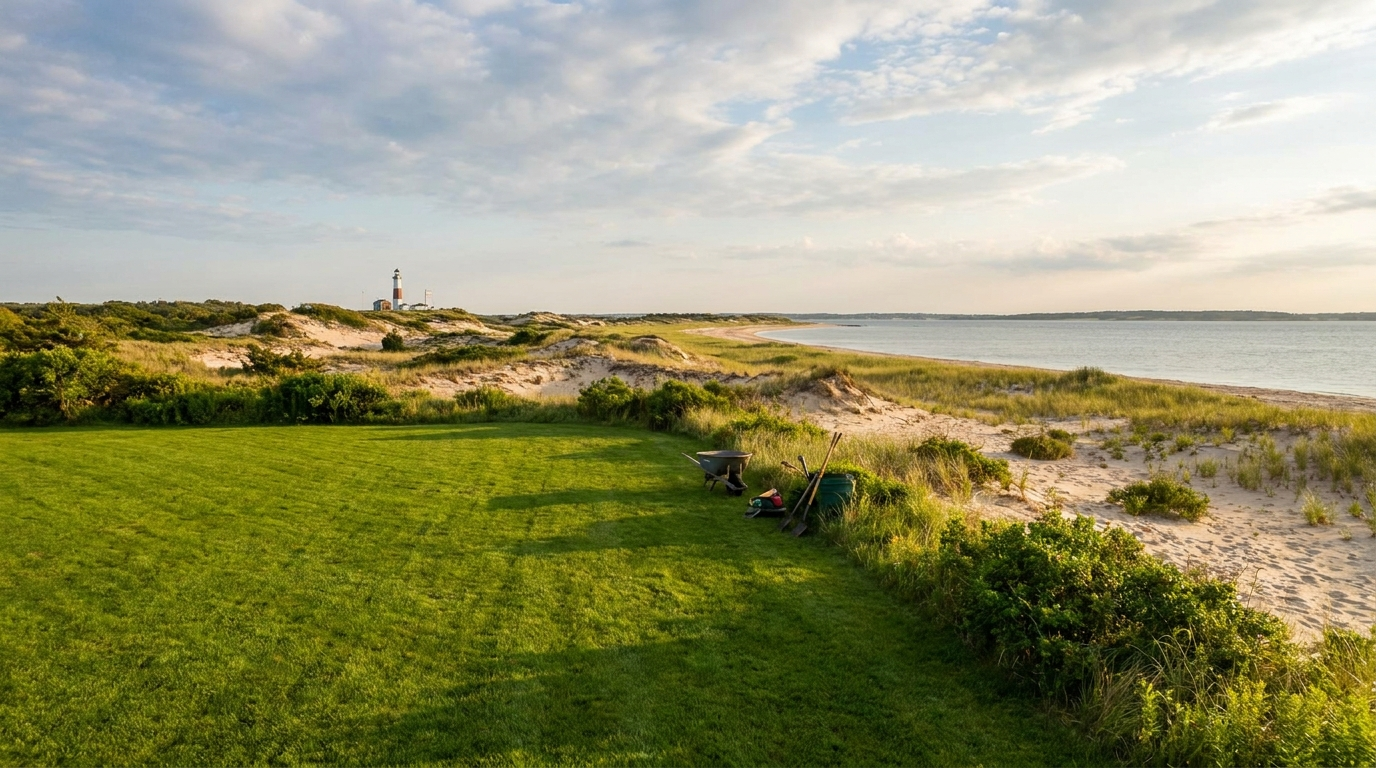
Most Long Island homeowners think of their lawn as a gardening problem. The real story starts roughly 20,000 years ago, when a continental ice sheet ground southward and deposited the very ground beneath East Islip's neighborhoods. Understanding that story, the geology, the hydrology, and the chemistry baked into the South Shore's soil, explains why generic lawn programs routinely underperform here, and why local expertise is not a luxury but a practical necessity.
How a Glacier Built the Ground Beneath Your Feet
The South Shore of Long Island is not just near the coast; it is, geologically speaking, made of the coast. During the last glacial advance of the Pleistocene (Wisconsin Stage), ice reached the southern part of Long Island, carrying huge amounts of rock debris from the north. When that ice eventually melted, it left behind two distinct landscape types that still define the island today.
The first is the terminal moraine, a ridge of unsorted boulders, clay, and sediment that marks the glacier's furthest push. The southern portion of Long Island consists of the older Ronkonkoma moraine, while the northern portion consists of the younger Harbor Hill moraine found along Long Island Sound. Everything south of the Ronkonkoma moraine, including East Islip and the communities lining the Great South Bay, sits on a fundamentally different formation: the glacial outwash plain.
The part of the island south of the Ronkonkoma terminal moraine is known as an outwash plain, a glacial depositional feature created by melted glacial water that flows sediment out from underneath the glacier and deposits it at the endpoint, creating a flat plain of sediment. Critically, this process sorted the sediment. These are delta-like formations that formed slowly as meltwater carried rock material southward; unlike the unsorted moraines, the outwash plains allowed particles to layer and be sorted out by sheets of slowly moving water that eventually formed into streams.
The result is a broad, flat expanse of predominantly fine-to-medium sand with very little clay content. The southern outwash plain is a flat, sandy expanse with average elevations starting at 100–150 feet near the moraines and gently sloping southward at about 20 feet per mile toward the coast. That gentle southward pitch is not just a topographic footnote, it governs how water moves through every South Shore yard, which has direct consequences for how lawns behave.
Why Sandy Outwash Soil Drains the Way It Does
Drainage is where glacial geology becomes a daily lawn care challenge. Sandy outwash soils have large pore spaces between particles, which means water moves through them quickly, often far faster than grass roots can absorb it. Most of Nassau and Suffolk County sits on glacial outwash plains with sandy loam soils from the Haven, Riverhead, and Plymouth soil associations. These soils drain fast, warm fast, and leach nutrients fast.
This rapid percolation creates a layered problem. Rainfall and irrigation water carry dissolved nutrients, nitrogen, potassium, phosphorus, downward through the soil profile before roots have a chance to intercept them. The soils on the South Shore and across the eastern stretches of Long Island tend to be sandy and fast-draining, which means fertilizer doesn't hold the way it does in heavier inland soils. A homeowner applying a standard fertilizer program designed for New Jersey clay or Connecticut loam is essentially watering their local aquifer rather than feeding their lawn.
The hydrology runs deeper than the root zone. Glacial outwash comprises fluvial sediments deposited in front of the ice margin and generally consists of well-sorted sand and gravel. This highly permeable layer forms what geologists call the Upper Glacial aquifer, the same formation that supplies drinking water to much of Long Island. Most surface drainage features on Long Island are along the southern shore, meaning the water that moves through a South Shore yard does not simply disappear. It percolates downward and, in many cases, eventually discharges into the Great South Bay. This is why Suffolk County has some of the most stringent residential fertilizer regulations in New York State: what goes onto the lawn can, in a very real hydrological sense, end up in the bay.
For lawn care purposes, the practical implication is that watering frequency and fertilizer formulation must be calibrated to fast-draining sandy soil, not to the national averages that most big-box product labels assume. About one inch of water per week is the general target during active growth, though sandy soils may need slightly more frequent applications since they drain faster.
The pH Problem Hidden in Coastal Sandy Soil
Drainage does more than carry away nutrients, it also changes the soil's chemistry over time. Sandy outwash soils are naturally low in organic matter and buffering capacity, which makes them prone to acidification. Sandy soils throughout Long Island run acidic to substantially acidic. On the South Shore specifically, sandy south shore soils tend to be slightly acidic, with pH readings commonly in the 5.5–6.5 range.
That range matters enormously because soil pH controls nutrient availability at the chemical level. When pH sits below 6.0, which is common in the sandy, fast-draining glacial soils, nitrogen, phosphorus, and potassium get chemically locked up in the ground. Grass cannot reach them, no matter how much product gets applied on top. This is one of the most common and costly misdiagnoses in South Shore lawn care: a homeowner applies fertilizer season after season and sees little improvement, not because the product is wrong, but because the soil pH is preventing uptake entirely.
Coastal proximity compounds the issue. Salt spray from the Great South Bay introduces sodium ions that can displace calcium and magnesium from soil particles, further destabilizing pH and reducing the soil's already-limited ability to hold nutrients. The cation exchange capacity (CEC) affects how much fertilizer holds in soil versus leaches through. Sandy coastal properties with low CEC often need more frequent fertilizer applications because of the lower nutrient holding capacity.
The fix is not complicated, but it requires accurate information first. The Cornell Cooperative Extension Horticulture Diagnostic Lab in Riverhead tests soils for pH and conductivity (soluble salts), and the service is available to homeowners as well as commercial growers. Operators with decades of South Shore experience know that soil tests for lawn and garden beds are recommended every three years, or whenever a problem is suspected , and on coastal properties, that interval is worth taking seriously.
The Soil Characteristic Matrix: South Shore vs. Inland Long Island
Understanding how South Shore coastal soil compares to inland Long Island profiles helps explain why a single landscaping approach cannot serve both environments. The table below maps the key variables that drive lawn care decisions on each soil type.
| Soil Characteristic | South Shore Outwash (East Islip Area) | North Shore / Inland Moraine Soils |
|---|---|---|
| Primary formation | Glacial outwash plain (sorted sand and gravel) | Glacial till moraine (unsorted boulders, clay, silt) |
| Texture | Sandy loam to loamy sand | Loam to clay loam |
| Drainage rate | ⚠️ Very rapid, nutrients leach quickly | ✅ Moderate, better nutrient retention |
| Typical pH range | 5.5–6.5 (often acidic) | 6.0–7.5 (variable, some alkaline) |
| Cation exchange capacity (CEC) | ❌ Low, poor nutrient holding | ✅ Higher, better buffering |
| Organic matter content | ⚠️ Naturally low; must be built over time | ✅ Moderate; easier to maintain |
| Salt exposure risk | ⚠️ Elevated (bay and ocean proximity) | ✅ Low to minimal |
| Fertilizer application frequency | Higher frequency, lower per-application rates | Standard frequency, higher per-application rates |
What Coastal Soil Science Means for East Islip Lawns
The geology and hydrology outlined above are not abstract, they translate directly into observable lawn behavior that South Shore homeowners encounter every season. The sandy, loamy soils near the Great South Bay drain nutrients out of the root zone fast. Salt air off the water stresses grass density in ways that fertilizer alone cannot fix. Understanding the underlying cause changes how a homeowner (or their landscaper) responds to those symptoms.
Consider a lawn that looks thin and patchy despite regular fertilization. The instinctive response is to apply more product. But on an outwash plain with low CEC and acidic pH, the problem is almost certainly chemical unavailability, not deficiency. Nutrients are chemically locked in the soil, you could apply the perfect amount of fertilizer at the perfect time and still see poor results because the nutrients cannot be accessed by grass roots. The correct intervention is a soil test, a lime application to correct pH, and a reformulated fertilizer program, not a heavier dose of the same product.
Organic matter is the other lever that coastal sandy soil demands. Annual applications of compost (2–3 inches tilled in or applied as top dressing), organic mulch that decomposes into the soil, and organic fertilizers all build the organic matter content that gives sandy soil more structure and water retention. This is a multi-season investment, not a single-season fix, and it requires consistent attention to show results. Operators who understand the soil health dynamics specific to Suffolk County know how to sequence these amendments correctly.
Grass variety selection is equally influenced by the soil profile. RTF and tall fescue (including Black Beauty) handle sandy coastal conditions better than Kentucky Bluegrass without intensive irrigation. Direct waterfront properties benefit specifically from fine fescue blends for salt tolerance. A crew that has worked South Shore properties across decades recognizes these distinctions from observation, not just from a reference chart.
Suffolk County also layers a regulatory dimension onto all of this. It is against the law to apply nitrogen fertilizers to lawns from November 1 through April 1 in Suffolk County , a restriction tied directly to the region's permeable outwash soils and the groundwater they feed. Compliance is not optional, and local landscapers with deep roots in the community are far more likely to operate within these rules than out-of-area crews unfamiliar with New York's coastal fertilizer regulations. Homeowners can verify current Suffolk County guidelines through the Suffolk County Healthy Lawns program, which also provides soil testing guidance.
Frequently Asked Questions About Long Island Coastal Soil
Why does my South Shore lawn need lime when my neighbor upstate doesn't?
Sandy outwash soils have low buffering capacity, meaning they acidify more readily than clay-rich inland soils. Sandy coastal soils typically run more acidic than inland clay-leaning soils, and South Shore properties often need more aggressive lime application than inland properties. Upstate soils with higher clay content resist pH swings naturally; South Shore soils do not.
Does salt air from the Great South Bay actually damage grass roots?
Yes, though the mechanism is indirect. Salt deposits sodium ions in the soil, which compete with potassium and calcium for uptake by grass roots. Over time this reduces grass density and stress tolerance. Grass variety selection matters more near the coast than it does inland. Not every cool-season grass performs equally under salt stress, and using the wrong seed mix for South Shore coastal conditions will show within a season or two.
How does the glacial outwash plain affect groundwater on Long Island?
Glacial outwash comprises well-sorted sand and gravel that forms a highly permeable upper aquifer. Submarine groundwater discharge from Long Island delivers nutrients into Great South Bay, making it a primary cause of eutrophication and harmful algal blooms. This is why what goes onto a South Shore lawn has environmental consequences well beyond the property line.
How often should I test my South Shore soil?
Industry guidance for Long Island recommends testing every two to three years at minimum, or any time a lawn shows unexplained decline. The Cornell Cooperative Extension Soils Lab in Riverhead is able to test soil pH and can provide instructions on how to take and submit a soil sample. Testing before applying any amendment program is the most cost-effective step a South Shore homeowner can take.
Key Takeaways for South Shore Long Island Homeowners
- The South Shore outwash plain is geologically distinct from the rest of Long Island. Its sorted, sandy composition is a direct product of glacial meltwater deposition, not regional topsoil variation.
- Fast drainage is the defining challenge. Nutrients leach through sandy outwash soil quickly, making fertilizer timing, formulation, and pH correction far more important than application volume.
- Low pH locks out nutrients. Sandy south shore soils commonly run below 6.0 pH, chemically preventing grass from accessing fertilizer regardless of how much is applied. A soil test is the essential first diagnostic step.
- Salt exposure is a real agronomic factor near the Great South Bay, influencing both soil chemistry and grass variety selection in ways that generic lawn programs do not account for.
- What leaves your lawn reaches the bay. The permeable outwash aquifer connects residential properties directly to coastal waterways, which is why Suffolk County enforces strict nitrogen fertilizer regulations.
- Local expertise is not interchangeable with general landscaping knowledge. The soil conditions in East Islip and surrounding South Shore communities require a practitioner who has read this particular land across many seasons, not one applying a national template to a locally specific problem. Landscapes by R. Wieland has been doing exactly that since 1980, with over four decades of hands-on experience in the Suffolk County growing environment that no amount of generic training can replicate.