
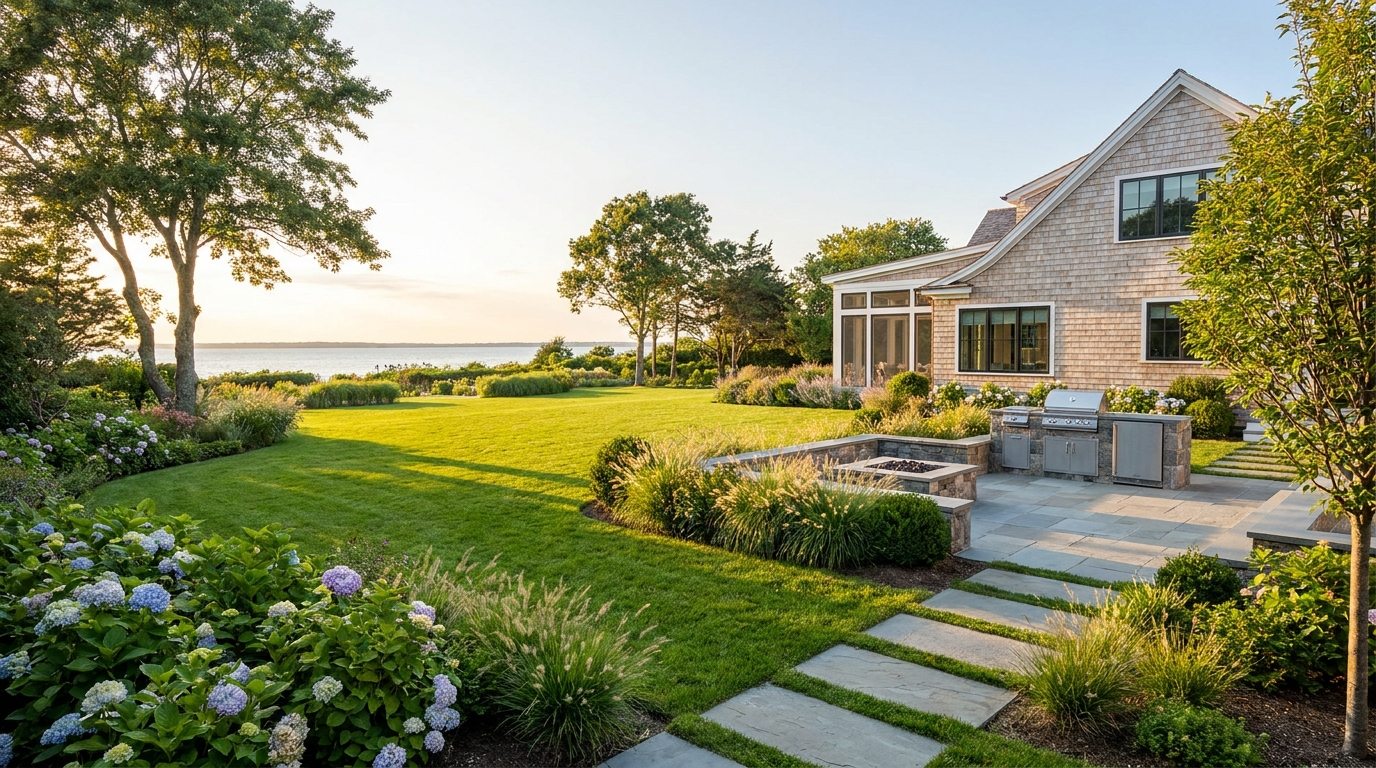
It's a Tuesday in late May, and a homeowner near the Great South Bay is standing on a new paver patio, watching a puddle form beside the grill. The patio looked great on the day it was installed. The hydrangeas planted along the edge are already scorched, the lawn nearby is thin, and the downspout empties right where the family wants to sit. Nobody did anything careless. The yard was built in pieces, and no one ever drew a plan connecting them.
That gap is what landscape design Long Island homeowners most often need filled. This guide explains what landscape design is, why South Shore conditions make it more important here than in many other places, and how to judge whether a plan is worth building.
What Is Landscape Design, Exactly?
Landscape design is the planning stage that decides how every part of an outdoor space works together before anything is planted or built. It covers grading, drainage, plant selection, hardscape placement, lighting, sun and wind exposure, and long-term upkeep. Planting is only the execution of that plan.
A useful way to see the difference: landscaping is the work, and design is the reasoning behind the work. A crew can install a patio, a walkway, and a dozen shrubs without any design at all. The result may look fine on day one, but it usually performs poorly in year three.
Good landscape planning Long Island properties benefit from starts with questions rather than products:
- How does water move? Where does it enter, pool, and leave the property?
- How does the family live outside? Dining, kids, pets, entertaining, quiet corners.
- What can the site support? Light, soil, salt exposure, and the local climate.
- What will it cost to keep? Mowing, irrigation, pruning, and seasonal cleanups.
Back at our patio, the puddle is a design failure, not a construction failure. Someone chose a paver location without reading the grade. What this means for you: before collecting quotes for any single feature, ask who is looking at the whole property. A single-feature quote can't solve a whole-property problem.
Why Does Landscape Design Matter More on the South Shore?
South Shore properties sit on glacial outwash, a sandy plain with a shallow water table, salt exposure, and strict local environmental rules. Those conditions punish improvised plantings and reward planned ones. Generic advice written for other regions often fails here.
Cornell's Long Island Horticultural Research and Extension Center describes Suffolk County's soils as having excellent drainage, moderate water-holding capacity, and modest fertility. Those traits come from thousands of years of glacial deposition. In practice, that means water and nutrients move through quickly, so plants dry out and go hungry faster than they would in heavier soil.
The South Shore adds a second wrinkle. Local drainage specialists note that neighborhoods near the Great South Bay can drain well at the surface while the water table sits only a few feet down, so heavy rain can saturate the ground from below. Surface regrading alone won't always fix that. Cornell Cooperative Extension's Long Island soil health pocket guide reinforces the point that Long Island has many types of sand, not one, and that drainage should be evaluated rather than assumed.
Climate matters too. Most of Suffolk County falls in USDA zones 7a to 7b, so the South Shore's milder winters allow a broad plant palette. Salt spray and summer heat still narrow what will thrive near the water. A skilled designer reads these layers together, which is why residential landscaping South Shore homeowners choose is rarely a copy of what works inland or upstate.
What this means for you: if a plan doesn't mention drainage, salt tolerance, and soil, it wasn't written for your property.
How Does Local Law Shape Long Island Outdoor Design?
Local regulation is a design input, not an afterthought. Suffolk County's fertilizer law shapes how lawns should be sized, planted, and fed, and it rewards designs that need less nitrogen to begin with.
Suffolk County Law 41-2007 was passed to reduce nitrogen pollution in groundwater and surface water. According to the county's Healthy Lawns, Clean Water notice, lawn fertilizer applications are prohibited from November 1 through April 1, and violators may be fined up to $1,000. The same notice suggests strategic landscaping and native plants that need less water and fertilizer. Meanwhile, the Suffolk County Water Authority reminds residents that groundwater is the county's sole source of drinking water, so what happens on your lawn reaches the aquifer.
Smart Long Island outdoor design responds in practical ways:
- Shrinking high-input turf in favor of planting beds, groundcovers, and ornamental grasses.
- Choosing tall fescue and other adapted cool-season grasses where lawn is wanted.
- Keeping fertilized areas away from water edges and drainage paths.
- Using mulch and organic matter to help sandy soil hold nutrients.
Operators in this market often describe a recurring pattern: homeowners who inherit a large, thirsty lawn pay for it every summer in water and every spring in repair work. A design that right-sizes the lawn cuts that recurring cost. What this means for you: ask any designer how the plan fits county rules and how it reduces long-term inputs.
What Does Professional Landscape Design in East Islip Include?
Professional landscape design in East Islip and similar South Shore communities typically moves through four stages: site analysis, concept planning, phased installation, and a maintenance handoff. The value lies in sequencing, because what happens first controls what happens last.
The framework below is an original way to size up a design process. Use it to compare proposals.
| Stage | What Should Happen | Red Flag If Missing |
|---|---|---|
| 1. Read the land | Walk the site, check grade, water flow, sun, salt exposure, and soil | ❌ A quote arrives without a site visit |
| 2. Plan the whole | Map zones for living, planting, circulation, and drainage | ⚠️ Features priced one at a time |
| 3. Phase the build | Grade and hardscape first, then soil prep, then plants in the right season | ❌ Plants installed before construction ends |
| 4. Hand off care | A seasonal calendar covering cleanups, pruning, feeding, and watering | ⚠️ No guidance on upkeep |
Revisit the scorched hydrangeas and puddled patio. Stage one would have caught the grade, and stage two would have moved the downspout. Stage three would have kept plants out of the construction zone. A family-owned firm that has worked the same communities for decades, as Landscapes by R. Wieland has since 1980, has typically seen how a given yard behaves through many storms and seasons, which is hard to replicate with a spreadsheet.
What this means for you: a design fee or planning visit usually costs far less than rebuilding a patio, so treat planning as insurance on the larger spend.
Frequently Asked Questions
Is landscape design the same as landscaping?
No. Design is the plan, and landscaping is the work of carrying it out. Skipping the plan often leads to drainage trouble, plant losses, and rework.
When should I start planning a project?
Plan early, even if you won't build for months. Design takes time, and good installation windows for plants are seasonal. Because fertilizer can't be applied from November 1 through April 1, fall and winter are sensible times to finalize a plan so spring work starts on schedule.
Do I need to test my soil first?
It helps. Cornell Cooperative Extension of Suffolk County offers soil pH testing and horticultural guidance, and results can steer amendments and plant choices before money goes into the ground.
Can a design plan be built in phases?
Yes, and it often should be. A master plan lets you build a patio this year and add plantings or lighting later without redoing earlier work.
What is the biggest mistake homeowners make?
Buying features one at a time without an overall plan. The result is usually mismatched materials, poor drainage, and plants in the wrong place.
Key Takeaways for South Shore Homeowners
- Design comes before installation. It decides how water, people, and plants interact across the whole property.
- South Shore conditions are specific. Fast-draining sandy soil, shallow water tables, salt exposure, and a mild zone 7 climate call for locally informed choices.
- Local rules are design inputs. Suffolk County's fertilizer blackout favors lower-input lawns, native plantings, and well-placed beds.
- Use the four-stage test. Look for a site visit, a whole-property plan, phased construction, and a maintenance handoff.
- Plan for upkeep. A beautiful yard that you can't afford or manage will not stay beautiful.
If you're weighing a patio, a planting refresh, or a full property rethink, start with a conversation about the land itself. A local team that knows East Islip and the surrounding South Shore communities can walk the site, explain what it can support, and help you sequence the work so the yard performs for years.