
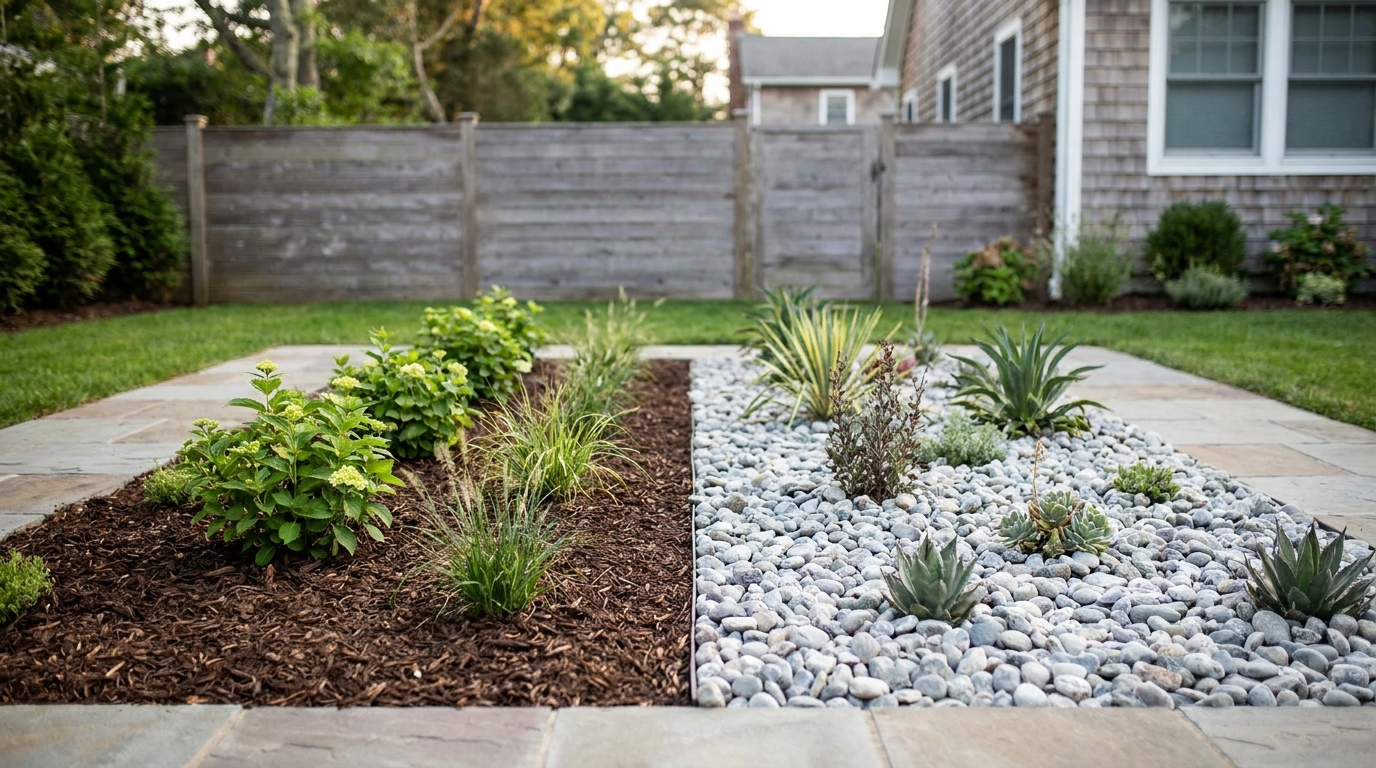
Walk down almost any street in East Islip and you will see the same quiet argument playing out in front yards. One neighbor refreshes dark hardwood mulch every spring. Another swears by crisp river stone and has not touched the bed in years. Both beds can look great in June. By the second or third summer, they behave very differently. The mulch vs stone Long Island question comes down to sandy soil, salt air, summer dry spells, and how much weekend time you want to spend on the bed.
Why Does Mulch Work So Well in Long Island's Sandy Soil?
Organic mulch is usually the better ground cover for planted beds on the South Shore. It slows evaporation, moderates soil temperature, blocks weed seeds from sunlight, and slowly feeds sandy soil that holds very little on its own. Most of the work is in doing it correctly.
The challenge is that Long Island soil drains fast. Local lawn-care sources describe the island's glacial outwash soils as sandy, light, and fast-draining, so water and nutrients move past roots quickly. Mulch is the cheapest way to slow that down. Cornell Cooperative Extension of Suffolk County notes that a 3-inch mulch layer can cut irrigation needs by up to 50 percent. As mulch breaks down, it also adds organic matter that improves the soil's water-holding ability.
Where Mulching Goes Wrong
Good mulching Long Island results depend on a few habits:
- Depth: Aim for 2–3 inches. Extension guidance generally warns against going much beyond 3 inches, which can reduce air reaching roots. Excess mulch in flower beds can also favor voles.
- Distance from stems: Keep mulch pulled back from trunks and crowns. The "mulch volcano" is a widely condemned practice that invites rot and pests. UNH Extension suggests 2–3 inches of clearance.
- Quality: The Suffolk County Cornell guide warns that sour-smelling mulch can harm plants. Use a sniff test before spreading.
- Timing: Spring mulch goes down once soil has warmed. Fall mulch helps buffer freeze-thaw swings.
The tradeoff is upkeep. Mulch decomposes, so it needs a periodic top-up, and it will not permanently smother perennial weeds such as nutsedge. A cubic yard spread 2 inches deep covers about 162 square feet, which is a handy way to budget a bed before ordering.
What Does Decorative Stone Landscaping in East Islip Do Well?
Stone is a durable, low-refresh cover that shines in dry, sunny, high-traffic, or drainage-sensitive spots. It does not rot, blow away, or float off in a downpour. It adds nothing to the soil, and it does not suit most moisture-loving plants.
The common frustration is that homeowners choose stone expecting a "no weeds, no work" bed, then find seedlings sprouting in the gaps within a couple of years. Windblown seed and fine debris collect between stones and create a growing medium on top of the fabric. Weeds that root in stone are also harder to pull. Extension guidance from Colorado State notes that plastic and woven weed fabrics are not recommended under mulch, and that advice is worth weighing before you lay fabric under any bed.
Choosing the Right Stone
Size and color matter more than most buyers expect. Colorado State's gardening notes say stones used as mulch should be smaller than half an inch for water conservation and weed suppression, and larger stone may inhibit plant growth. Dark stone absorbs and radiates heat, which can stress shallow-rooted perennials. Light stone reflects it, which can scorch foliage near south-facing walls.
Where decorative stone landscaping East Islip projects make the most sense:
- Drip lines along rooflines, where rain splashes mulch out of the bed
- Narrow side-yard strips and utility areas
- Borders next to patios and walkways
- Beds with lavender, sedum, ornamental grasses, and other drought-tolerant plants
- Slopes or low spots where mulch tends to wash out
The honest downside is permanence. Stone is heavy and hard to remove, and mixing it into soil is difficult to undo. If you may change the bed later, think carefully before committing.
How Do They Compare Head to Head?
Mulch wins on plant health and flexibility. Stone wins on longevity and defined, tidy edges. Neither is the best landscape ground cover Long Island homeowners can use everywhere, so match the material to the planting.
The trap is choosing for looks alone. A bed that photographs well on installation day can underperform if the material fights the plants. Use the table below, and then the scoring framework that follows it.
| Factor | Organic Mulch | Decorative Stone |
|---|---|---|
| Moisture retention | ✅ Reduces evaporation | ❌ Little benefit; drains fast |
| Soil improvement | ✅ Adds organic matter | ❌ None |
| Weed control | ✅ Strong at 2–3 inches | ⚠️ Weakens as debris collects |
| Refresh frequency | ⚠️ Periodic top-ups | ✅ Rarely |
| Heavy rain and slopes | ⚠️ Can wash out without edging | ✅ Stays put |
| Upfront labor and cost | ✅ Lower | ⚠️ Higher; heavy to install |
| Best plants | Hydrangeas, hostas, shrubs, perennials | Sedum, lavender, grasses, Mediterranean types |
The Three-Question Bed Test
For each bed, ask these questions and count your answers:
- Do the plants want steady moisture? If yes, score a point for mulch.
- Is the spot dry, narrow, sloped, or next to a hard surface? If yes, score a point for stone.
- Will you refresh the cover without a reminder? If no, score a point for stone.
Two or more points for one material is your answer. A split is common, and many South Shore properties end up with both.
Which Should You Choose for Your South Shore Property?
For most planted beds, choose mulch. Use stone as a deliberate accent, not a blanket solution. That is the practical answer for a typical garden bed ground cover South Shore homeowners need, where sandy soil and summer dry spells punish thirsty plants.
The reason is simple. Sandy soil already struggles to hold water, so a cover that improves it is working in your favor. A stone-only yard asks plants to survive a harder environment than they need to.
Scenario-Based Recommendations
- If you have foundation shrubs, hydrangeas, or perennials: choose mulch.
- If you have new trees and shrubs: choose mulch. Cornell Cooperative Extension says 2–3 inches helps keep new transplants' roots moist during dry spells.
- If you want a clean border along a patio or walkway: choose stone, or a stone strip with mulch behind it.
- If roof runoff or a slope keeps washing out your bed: choose stone for that section.
- If budget is your priority: choose mulch. Stone costs more upfront, though it can pay back if you would otherwise replace mulch every year.
- If you want the least ongoing work: choose small stone over properly prepared soil and plan on occasional spot-weeding and debris removal.
A Note on Fertilizer Rules
Beds are not lawns, but they sit beside them. Suffolk County restricts lawn fertilizer, and the county's Healthy Lawns program prohibits fertilizer applications between November 1 and April 1. Mulch helps by holding nutrients and water in the root zone, which reduces how much you need to add elsewhere.
Key Takeaways
- Mulch is best for plant health, moisture, and soil improvement.
- Stone is best for drainage-prone spots, borders, and drought-tolerant plantings.
- Keep both materials away from stems and trunks, and use small stone sizes.
- Many properties do best with a mulch and stone combination.
Frequently Asked Questions
Is mulch or stone cheaper for Long Island garden beds?
Mulch is usually cheaper to install. Stone costs more upfront because it is heavier and labor-intensive to place, but it avoids annual refreshing. Compare multi-year costs, not just the first invoice.
How deep should mulch be?
Two to three inches is the standard extension guidance. Keep it pulled back from trunks and plant crowns so moisture does not sit against the bark.
Does landscape fabric stop weeds?
Not permanently. Seeds sprout in debris that collects on top of the fabric. Cornell's Suffolk County guide says fabric may help with some persistent weeds like nutsedge, while Colorado State advises against plastic and woven fabrics under mulch. Prepare the bed and apply the right depth instead.
Can I use both in the same yard?
Yes, and it is often the best approach. Use mulch around plants and stone along hard edges, drip lines, and slopes.
When should I mulch on the South Shore?
Spring mulching works best once the soil has warmed. Fall mulching helps protect roots from freeze-thaw cycles. For a bed-by-bed recommendation, a local landscaper familiar with East Islip soil can walk the property with you.