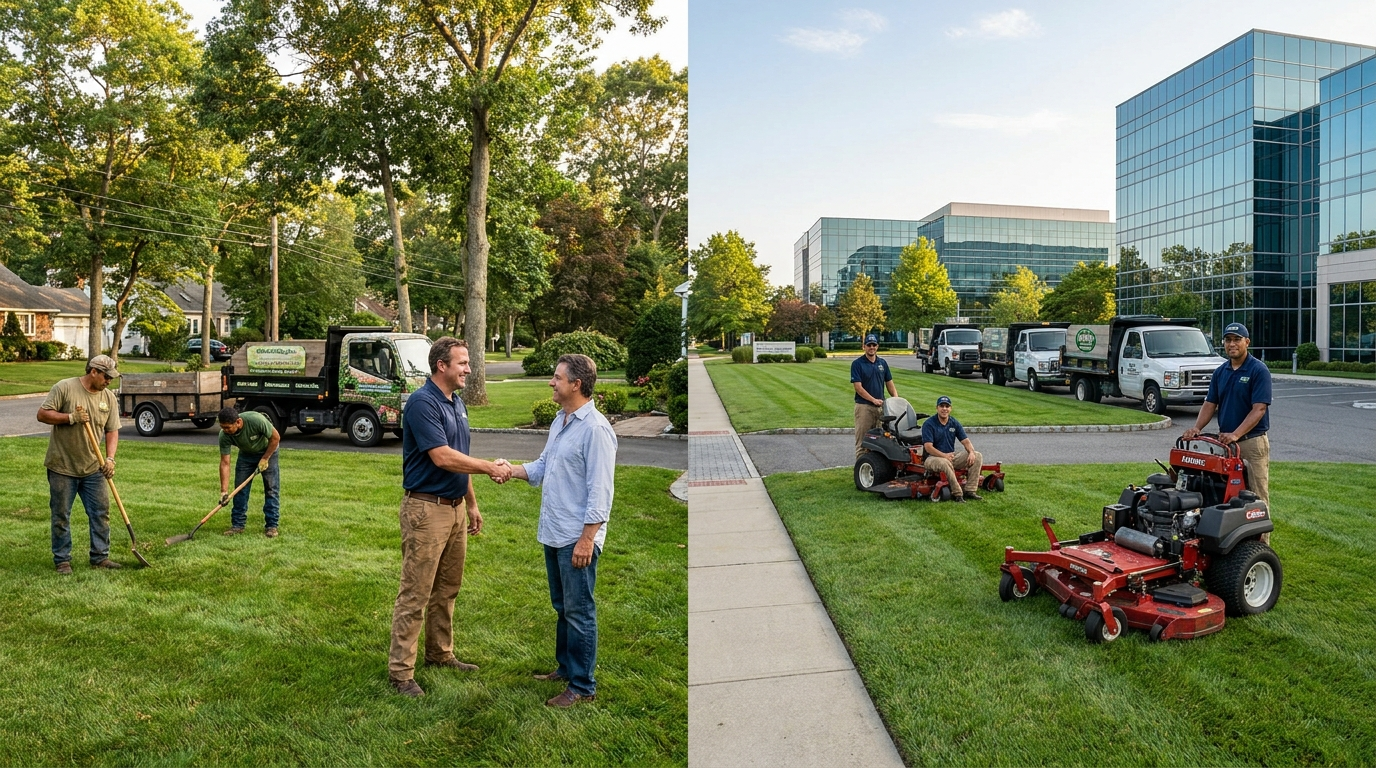
Picture this: it's a Thursday morning in early April on the South Shore. A large branded truck pulls up to a house two doors down. Three workers climb out, spend about 22 minutes on the property, and leave without speaking to anyone. The homeowner calls the company's 800 number that afternoon to ask why the crew skipped the back corner beds. She's put on hold, transferred twice, and told a supervisor will call her back. He doesn't.
That scenario plays out across Long Island every season. And it's the exact reason so many South Shore homeowners are rethinking who they trust with their property. When you're choosing a landscaper on Long Island, the choice between a family-run operation and a corporate chain isn't just about price or convenience. It's about what your yard actually looks like in June, and who picks up the phone when something goes wrong in October.
This comparison breaks down both models honestly, covers what each delivers well, and gives you a clear framework for making the right call for your specific situation.
How Corporate Landscaping Companies Actually Operate
Corporate and franchise landscaping operations have real advantages, and dismissing them entirely would be dishonest. Understanding how they're structured helps explain both their strengths and their most common failure points.
The corporate model is built around volume and operational efficiency. These entities have a more formal legal structure and prioritize shareholder returns and the ability to scale. That scale brings resources: branded fleets, centralized scheduling software, and in some cases, the ability to deploy crews quickly during high-demand windows. National lawn care chains do some things well. They have established brands, predictable pricing structures, and operational efficiency from treating thousands of properties.
Where the model starts to strain is at the property level. The person who gives you the professional quote is rarely the person actually operating the equipment on your property. High staff turnover in big firms often means that inexperienced workers are sent to local jobs to learn on the fly. This isn't a management failure so much as a structural inevitability: when a company is optimizing for route density and per-stop targets, individual property attention becomes a secondary concern.
National chains optimize for volume. They schedule as many stops per route as possible, spend the minimum time on each property, and move on. Your lawn is essentially an account number on a spreadsheet in a regional office.
Contracts are another friction point. Local contracts are usually short, written in plain English, and have clear out clauses. National contracts are usually long, written by legal teams, and include automatic renewals, late fees, cancellation fees, and language that survives ownership changes on the property. Homeowners frequently discover these terms only when they try to cancel or dispute a service.
Corporate chains can also struggle with the kind of adaptive, on-the-ground judgment that Long Island's conditions demand. Corporate headquarters often dictate protocols for thousands of branches, regardless of local nuances. A treatment plan designed in a corporate office three states away might not account for the specific soil acidity, pest pressures, or micro-climates of your area. On the South Shore, where soil and climate behave differently from almost anywhere else in the Northeast, that gap matters enormously.
What a Family Landscaping Company on Long Island Actually Delivers
A family landscaping company on Long Island operates under a fundamentally different set of incentives. The owner's name is on the truck, their neighbors are often their clients, and their reputation is built one yard at a time over years, not quarters.
The most meaningful difference is accountability at the crew level. When you hire a local family-owned landscaping company, you are choosing a team where the people signing the contracts are the same ones getting their boots muddy in your garden. This structure shifts the focus from hit-and-run profit margins to building a legacy within the community.
When you choose a family-run business, you don't have to worry about countless phone calls to speak with the right person. Instead, you can enjoy direct access to decision-makers, faster and more responsive customer service, and generally less runaround compared to national companies.
Crew consistency is another practical advantage. Customers care about consistency. They want to see the same person at each visit. They want to build a relationship with someone who knows their property. With corporate operations, you're more likely to get whoever's on the schedule that day. A family-run crew that has maintained your property for multiple seasons knows that the drainage in the northwest corner gets soggy after heavy rain, that the ornamental beds near the front walk need lighter trimming, and that you prefer the lawn edged before the driveway is blown. That institutional knowledge of your specific property doesn't transfer through a work order.
On the pricing side, local independent companies usually come in 10 to 20 percent under the national chains, and the reason is structural rather than a difference in quality. There is no franchise fee and no call center in between, so more of what you pay goes into the work.
Perhaps most critically for Long Island homeowners, a locally rooted company brings genuine regional knowledge. Suffolk County's local companies are preferable to national businesses since they have experience working within your unique microclimate, and they are well-versed with local rules, restrictions, and the most likely plant types to flourish. For a company like Landscapes by R. Wieland, which has been working South Shore soil since 1980, that knowledge isn't a marketing claim. It's the product of four decades of seasonal observation on the same terrain.
Why Long Island Soil Changes Everything
The soil beneath your South Shore lawn is genuinely unlike most of the Northeast, and it's the single biggest reason local expertise matters more here than in other markets. Any landscaper who treats Long Island like a generic New York suburb is working from the wrong playbook.
Suffolk County's ground is a product of glacial history. Most of Nassau and Suffolk County sits on glacial outwash plains with sandy loam soils. These soils drain fast, warm fast, and leach nutrients fast. A fertilizer rate designed for New Jersey clay doesn't work here.
This has direct consequences for how a lawn should be maintained. Long Island's sandy soil drains quickly and leaches nutrients faster than the clay-heavy soils found elsewhere in the Northeast. That means fertilization timing and product selection here require a different approach than what a national chain's standard program is built around.
The South Shore adds another layer of complexity: Suffolk County's soil is predominantly sandy loam, a legacy of glacial deposits, which drains fast, dries out quickly in summer, and requires a fertilization approach that's meaningfully different from what works in other parts of New York. Add coastal salt exposure from the Great South Bay and the Atlantic, and you've got a plant environment that punishes generic maintenance programs.
There's also the regulatory dimension. Suffolk County fertilizer blackout periods don't exist anywhere else in the state , meaning a landscaper unfamiliar with local rules can inadvertently put a homeowner in violation. A company with 45 years of South Shore history has navigated every regulatory shift this county has produced. A franchise crew rotating through the area for a season has not.
Understanding when to start spring cleanups, which cool-season grass varieties hold up against salt air, and how to time pre-emergent applications to the actual soil temperature at the Islip station rather than a national calendar: that's the kind of localized knowledge Cornell Cooperative Extension Suffolk County consistently emphasizes as critical for Long Island lawn health.
Side-by-Side: Family-Run vs. Corporate Landscaper
The table below maps the most decision-relevant differences between a well-established local vs corporate landscaper on the South Shore. Use it as a quick-reference when evaluating quotes.
| Factor | Family-Run (e.g., Landscapes by R. Wieland) | Corporate / Franchise Chain |
|---|---|---|
| Crew Consistency | ✅ Same crew, season after season | ⚠️ Rotating crews, high turnover |
| Local Soil Knowledge | ✅ Deep, property-specific expertise | ❌ Standardized programs, generic timing |
| Communication | ✅ Direct access to decision-maker | ❌ Call centers, account managers |
| Pricing Transparency | ✅ Itemized, plain-language quotes | ⚠️ Risk of hidden fees, fuel surcharges |
| Contract Flexibility | ✅ Seasonal or month-to-month options | ❌ Auto-renewal, cancellation fees common |
| Regulatory Compliance (Suffolk Co.) | ✅ Familiar with local blackout rules | ⚠️ May apply generic state protocols |
| Overall Pricing | ✅ Typically 10–20% lower (no franchise overhead) | ⚠️ Higher base cost, add-on fees likely |
| Full-Service Range | ✅ Lawn care, design, hardscaping, cleanups under one relationship | ⚠️ May specialize in one service only |
Frequently Asked Questions: Choosing a Landscaper on Long Island
Is a family-run landscaper actually less expensive than a corporate chain?
In most cases, yes. Because family-run operations carry no franchise fees and no national advertising overhead, more of what you pay goes directly into labor and materials. Industry pricing data consistently shows that local independent companies usually come in 10 to 20 percent under national chains for equivalent service scope, and you tend to get the same crew on every visit working a schedule that bends around your property. That said, always compare itemized quotes rather than headline prices, since corporate bids sometimes look lower until fuel surcharges and service-add fees are applied.
What should I ask a Long Island lawn service before hiring them?
Ask who will actually be on your property each visit, whether the same crew returns consistently, and how local regulatory requirements like Suffolk County fertilizer blackout windows are factored into their schedule. Ask for a written, itemized quote and check whether the contract includes auto-renewal clauses or cancellation fees. A company with deep South Shore roots should be able to speak specifically about your soil type and seasonal timing without consulting a corporate manual.
Does crew consistency really affect lawn quality?
It does, significantly. National chains have high employee turnover and service large territories. You might get a different crew every visit. They don't know your property, don't remember specific requests, and don't notice when a drainage issue in a corner is getting worse. A consistent crew builds an evolving picture of your property across seasons, which translates directly into better decisions and fewer problems going unnoticed.
Are corporate landscapers ever the better choice?
There are scenarios where a larger operation makes sense: very large commercial properties that need multi-crew deployment, or clients who simply want the most basic mowing service and have no preference for continuity. For residential homeowners on the South Shore who want quality lawn maintenance, landscape design, seasonal cleanups, or hardscaping delivered by people who know their property and their neighborhood, a local East Islip landscaping company with a proven track record will almost always deliver better outcomes.
The Honest Recommendation for South Shore Homeowners
After mapping both models against what Long Island homeowners actually need, the case for a family-run operation is not just sentimental. It's structural.
The South Shore's glacial sandy loam soils and coastal salt exposure demand a maintenance approach calibrated to this specific environment, not a program written for a national average. The fertilizer timing, the pre-emergent windows, the overseeding schedule for fall in Suffolk County: all of it requires genuine local knowledge that a rotating corporate crew simply cannot replicate.
If your priority is the lowest possible headline price with no interest in continuity or customization, a corporate chain may technically meet that need. But most Long Island homeowners who go that route find themselves switching within a season or two, frustrated by inconsistent crews, impersonal service, and lawns that never quite respond the way they should.
If you want a Long Island lawn service that knows your property, answers the phone directly, and brings 45 years of South Shore soil knowledge to every visit, a family-run company like Landscapes by R. Wieland is the clear choice. The difference shows up not in a single visit, but in how your lawn looks at the end of every season, and how easy it is to get answers when you need them.
The bottom line: For East Islip and South Shore homeowners who value quality, accountability, and a genuine relationship with the crew working their property, a local family landscaping company on Long Island consistently outperforms the corporate alternative on every metric that matters at the end of the growing season.
Key Takeaways
- Corporate landscapers optimize for volume and route efficiency, which often means rotating crews, standardized programs, and slower communication response times.
- Family-run companies on Long Island offer direct owner accountability, consistent crews, and local knowledge that corporate protocols cannot replicate.
- Suffolk County's glacial sandy loam soils, coastal salt exposure, and county-specific fertilizer regulations make local expertise a practical necessity, not just a preference.
- Local independent landscapers typically come in 10–20 percent below national chain pricing because they carry no franchise fees or national advertising overhead.
- Corporate contracts frequently include auto-renewal clauses, cancellation fees, and opaque line items. Family-run agreements tend to be plain-language and flexible.
- When choosing a landscaper on Long Island, ask specifically about crew consistency, local regulatory knowledge, and whether the person quoting you will also be managing your property.
Sources
- The Importance of a Family Owned Lawn Care Company: 7 Things You Should Know
- Local Lawn Care vs. National Chains in Tulsa
- Local Family Owned Landscapers: Myth vs. Reality for Your Backyard
- Local vs National Lawn Service, What Actually Differs
- Why Hiring Local Landscapers Beats National Chains Every Time
- Family-Owned vs Corporate Pest Control: Which Protects Your Hernando County Home Best?
- How Much Do Most Lawn Care Companies Charge in 2026
- How to Find a Great Long Island Landscaper