
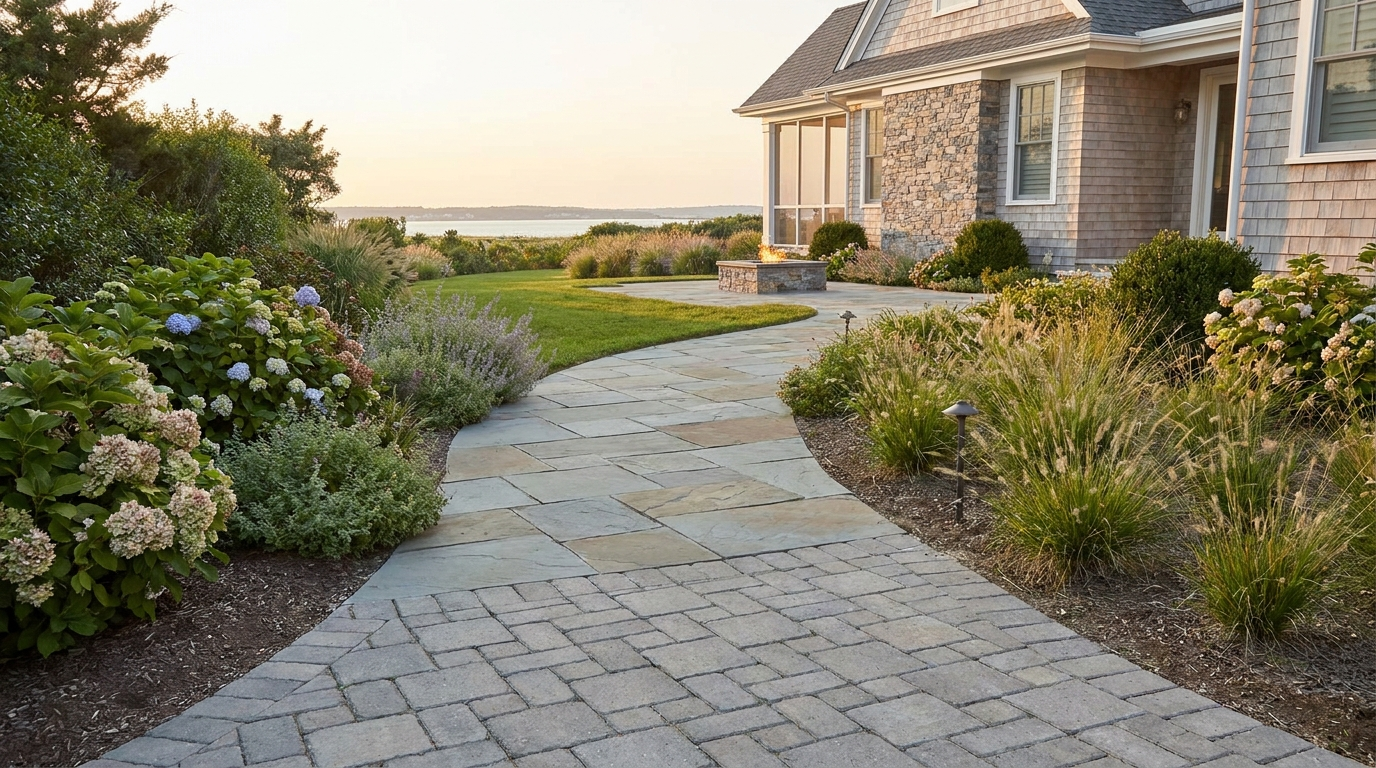
Most South Shore homeowners spend more time picking kitchen countertops than they do choosing the material for their front walkway. That's a problem, because the walkway takes far more abuse. It faces Long Island's freeze-thaw swings every single winter, gets coated in de-icing salt, and sits exposed to coastal moisture year-round. Pick the wrong material and you're dealing with cracked surfaces and shifting slabs within a few seasons. Pick the right one and it outlasts the mortgage.
This comparison cuts through the marketing language and gives East Islip and South Shore homeowners a straight answer on what actually works here, what it costs, and which material belongs on which property.
Why Long Island's Climate Changes the Conversation Entirely
Before comparing materials, it's worth understanding why a generic "pavers vs. stone" article written for a Phoenix or Atlanta audience doesn't apply here. What makes Long Island's climate particularly hard on hardscaping isn't extreme cold, it's the oscillation. Unlike upstate New York, where temperatures often stay well below freezing for weeks at a time, Suffolk County's maritime climate produces frequent swings above and below 32°F throughout the season.
Local sources report 25 to 35 of these freeze-thaw crossing events in a single winter, meaning 25 to 35 rounds of expansion and contraction stress on every porous surface on your property.
The mechanics of that damage are straightforward but destructive. Water infiltrates the pores of stone or the base beneath a paver. When temperatures drop below freezing, that water expands by roughly 9% as it turns to ice, exerting pressure on the surrounding material from the inside. When it thaws, the water contracts, more water enters, and the cycle repeats.
Long Island throws freeze-thaw cycles, salt exposure from both coastal air and winter de-icing, heavy rainfall, and ground movement at outdoor surfaces. Materials that work perfectly in Arizona or Florida fail here within a few seasons. Any walkway material comparison for this region has to start with that reality, not aesthetics, not price per square foot.
Concrete Pavers: The Practical Workhorse for South Shore Properties
Concrete pavers are the dominant choice across Nassau and Suffolk Counties for good reason. Their design philosophy actually suits Long Island's conditions. Unlike a monolithic concrete slab, an interlocking pavement system can flex slightly as the base and soil respond to seasonal temperature changes. That movement helps distribute loads and reduces the risk of one large crack spreading across the entire surface.
The joints between pavers aren't a weakness, they're a drainage system. Water moves through those gaps naturally instead of sitting on the surface looking for a way in. That reduces the amount of standing water that can freeze and cause damage. And when a single unit does get damaged, individual units can shift slightly with ground movement without the catastrophic cracking you see with poured concrete slabs, and when one paver does get damaged, you replace just that unit instead of tearing out an entire section.
Not all concrete pavers are created equal, though. Quality varies significantly. Premium products manufactured to ASTM standards with proper air entrainment handle freeze-thaw cycles far better than budget options from big box stores. Those microscopic air pockets built into better pavers give expanding ice somewhere to go instead of cracking the material from the inside. For Long Island projects, manufacturers like Cambridge and Nicolock are Long Island and Northeast producers whose products are designed and tested for local conditions, local soil types, local freeze-thaw cycles, and local salt air.
Nicolock pavers are manufactured right here on Long Island in Lindenhurst, NY , which means their specifications are calibrated for exactly the conditions South Shore homeowners face.
On the cost side, standard concrete pavers from Cambridge or Nicolock lines generally land in the $20 to $25 per square foot range when installed, with premium concrete options featuring textured finishes or larger formats running $25 to $30. For a typical front walkway of 150–200 square feet, that puts the total investment in the $3,000–$6,000 range, depending on design complexity and site conditions.
Ideal for: Budget-conscious homeowners, properties where a uniform, clean look complements the architecture, anyone who wants straightforward long-term maintenance, and situations where future repairs need to be simple and affordable.
Natural Stone: The Premium Choice for Curb Appeal and Longevity
Natural stone, primarily bluestone, flagstone, and granite on Long Island, carries a higher upfront cost, but it earns that premium in ways that matter over a 20- or 30-year ownership horizon. Bluestone is a true Long Island favorite. This dense, durable sandstone is known for its rich color palette, which ranges from blue-gray to green and lilac, and its naturally textured surface provides excellent slip resistance, making it an ideal and safe choice for walkways.
This dense sandstone quarried primarily in New York and Pennsylvania offers exceptional strength that makes it ideal for high-traffic areas. Bluestone's lower porosity means it resists staining and weathering better than many alternatives, translating to less frequent maintenance and a longer lifespan. For a South Shore property exposed to salt air and freeze-thaw cycles, that density matters enormously.
The freeze-thaw performance of natural stone depends heavily on the specific stone selected and how it is installed. Natural bluestone is a durable and classic choice for Long Island. This natural stone resists damage from harsh winter freeze-thaw cycles very well. However, bluestone absorbs water and needs proper sealing to stop staining from leaves, spills, or winter salt. Softer stones like limestone require more careful selection. Limestone is more porous than granite or bluestone, which means water absorption becomes a consideration. In freeze-thaw conditions, absorbed water expands when frozen, potentially causing cracks or surface flaking. This doesn't disqualify limestone for Long Island projects, but it does mean proper sealing is essential.
The cost picture for natural stone on Long Island reflects its premium positioning. A bluestone installation on Long Island typically costs between $18 and $38 per square foot for materials and professional installation. The higher price reflects quarrying costs, heavier shipping weight, and the skilled labor required to cut, fit, and set irregular stone. While the initial cost is higher than concrete, a bluestone walkway or patio adds significant curb appeal and property value, you are paying for a durable, timeless feature that will not fade or require frequent replacement.
Ideal for: Homeowners prioritizing long-term property value, those who want a distinctive, organic aesthetic that no manufactured product can replicate, and properties where a stone walkway creates a cohesive design statement alongside natural landscaping or stone walls.
Side-by-Side: The Honest Comparison Matrix
The table below reflects real installed costs and performance characteristics specific to Long Island's climate and market. Use it as a starting framework before getting local quotes.
| Factor | Concrete Pavers | Natural Stone (Bluestone/Granite) |
|---|---|---|
| Installed Cost (Long Island) | $20–$30 per sq ft | $18–$38+ per sq ft |
| Expected Lifespan | 25–50 years with quality install | 50–100+ years |
| Freeze-Thaw Performance | ✅ Excellent (interlocking flex system) | ✅ Excellent (dense stone; sealing required) |
| Salt/Coastal Air Resistance | ⚠️ Good (premium brands perform better) | ✅ Strong (granite best; bluestone needs sealing) |
| Maintenance | Polymeric sand refill; occasional sealing | Periodic sealing; weed management in joints |
| Repair Ease | ✅ Simple unit replacement (color matching may fade) | ⚠️ Possible but harder to match aged stone |
| Aesthetic Consistency | Uniform, clean, many pattern options | Organic, unique, no two installations alike |
| DIY-Friendly | ⚠️ Possible for experienced DIYers | ❌ Skilled mason strongly recommended |
| Property Value Impact | Positive, clean, durable appearance | Strong, premium material signals quality |
| Local Availability (Long Island) | ✅ Widely available (Cambridge, Nicolock) | ✅ Available (bluestone sourced from NY/PA quarries) |
The Decision Framework: Which Material Belongs on Your Property?
Both materials can perform well on Long Island, the right choice depends on your priorities, your property's character, and how you plan to use the space. Here is a practical decision framework built around the scenarios that come up most often on South Shore properties.
Choose concrete pavers if: Your project budget is under $30 per square foot installed, you want maximum design flexibility with colors and patterns, you prefer a material that's easy to repair by a local contractor years from now, or your home's architectural style suits a clean, structured look. Concrete pavers hold up very well because they flex with the freeze-thaw cycles of Nassau and Suffolk Counties. Leading local brands like Nicolock, made right in Lindenhurst, use special shields to resist fading and salt damage. When set on a properly compacted six-inch base, these pavers stop cracking and shifting, lasting twenty-five to fifty years. For a walkway in East Islip or Bay Shore where practicality and long-term value matter more than prestige material, a quality concrete paver installation is a sound investment.
Choose natural stone if: You want a walkway that genuinely improves with age and cannot be replicated by a manufactured product, you're planning a high-end landscape design where bluestone or granite coordinates with other stone elements, or you view the walkway as a long-term property investment rather than a maintenance item. A professional installation on Long Island costs between $20 and $40 per square foot depending on the chosen stone thickness, size, pattern, and layout. Installing natural stone over a solid, compacted aggregate base prevents shifting, making it one of the best materials for Long Island homeowners. It lasts for decades with simple power washing and resists stains when properly sealed.
One pattern that experienced local hardscaping contractors observe repeatedly: homeowners who install concrete pavers at a lower price point are often satisfied for 15–20 years, but those who invest in quality natural stone rarely regret it. The caveat is installation quality. A well-built front walkway in Long Island's climate should last 25 to 30 years. The difference between one that does and one that doesn't is usually in the work you never see, the base, the drainage, the edge restraints, the compaction. That's where the real cost justification lives. Regardless of which material you choose, cutting corners on base preparation is the single fastest way to waste your investment on Long Island's frost-heaving soil.
For homeowners in East Islip and across the South Shore, working with a contractor who has hands-on experience with Long Island's specific freeze-thaw and coastal conditions is as important as the material choice itself. A beautifully specified stone walkway installed over an inadequate base will fail. A properly installed concrete paver walkway on a six-inch compacted aggregate base will last decades.
Frequently Asked Questions: Pavers vs. Natural Stone on Long Island
Does natural stone crack in Long Island winters?
Dense stones like bluestone and granite handle freeze-thaw cycles very well when properly installed and sealed. When properly installed and maintained, natural stone pavers can last for generations. They are highly resistant to weathering, freeze-thaw cycles, and heavy foot traffic. However, softer stones may chip or stain more easily. Regular cleaning and, for some types, sealing, will help preserve their appearance. Softer or more porous options like limestone require more careful stone selection and consistent sealing.
Are concrete pavers cheaper than natural stone for a Long Island walkway?
Upfront, yes. Concrete pavers typically run $20–$30 per square foot installed, while natural stone runs $18–$38+ per square foot depending on the stone type and project complexity. Over a 30-year period, however, natural stone's longer lifespan and lower annual maintenance costs can narrow or close that gap significantly.
What base preparation does a Long Island walkway need?
Both materials require a properly compacted aggregate base, typically six inches of crushed stone, to prevent frost heaving and shifting. Concrete pavers are made to expand and contract without cracking, while bluestone is a dense natural stone that withstands cold temperatures. Both materials need a solid six-inch base of compacted gravel to stop shifting during winter freezes. Skimping on base depth is the most common cause of premature walkway failure on Long Island.
Which material adds more curb appeal in South Shore communities?
A stone walkway in Suffolk County can give a property a more natural and timeless look. Flagstone has a relaxed, irregular appearance, while bluestone offers a cleaner and more structured finish. Both materials can work well around front entries, patios, and landscaped areas. Concrete pavers in premium patterns and colors also deliver strong curb appeal, particularly on homes with a more contemporary or traditional suburban aesthetic.
Key Takeaways for South Shore Homeowners
- Long Island's freeze-thaw climate is the deciding factor. With 25–35 freeze-thaw cycles per winter in Suffolk County, base preparation and material density matter more than aesthetics alone.
- Concrete pavers are the practical, cost-effective choice. Local brands like Nicolock (Lindenhurst) and Cambridge are engineered for Northeast conditions and offer 25–50 year lifespans with proper installation.
- Natural bluestone is the premium, long-term investment. Quarried in New York and Pennsylvania, it outlasts concrete pavers and improves with age, but requires sealing and skilled installation.
- Both materials need a six-inch compacted aggregate base. The base is what determines longevity on Long Island's frost-heaving soil, not the surface material alone.
- The lifecycle cost gap is smaller than it appears. Natural stone's higher upfront cost is partially offset by lower annual maintenance and a significantly longer replacement cycle.
- Work with a contractor who knows South Shore conditions. Forty-plus years of local experience in East Islip and surrounding communities is not a marketing line, it's the difference between a walkway that shifts in year three and one that looks great in year thirty.
Sources
- Natural Stone Restoration on Long Island: Fix Coastal Climate Damage
- Paver Driveways Long Island: Materials Comparison Guide
- Concrete vs Pavers: Which Survives Long Island Winters?
- Walkway Paver Design Ideas for Long Island Properties
- Paver Patio Pricing Long Island 2026, 5★
- Nicolock Pavers Long Island: Products, Colors & 2026 Pricing Guide
- Paver Patio Cost Guide for Long Island 2026
- How to Find the Best Natural Stone Supplier Long Island